
Developing an Enterprise AI Governance Framework for the Agentic Era
By Vasudevan Kidambi
Originally published on blog.navoinc.com
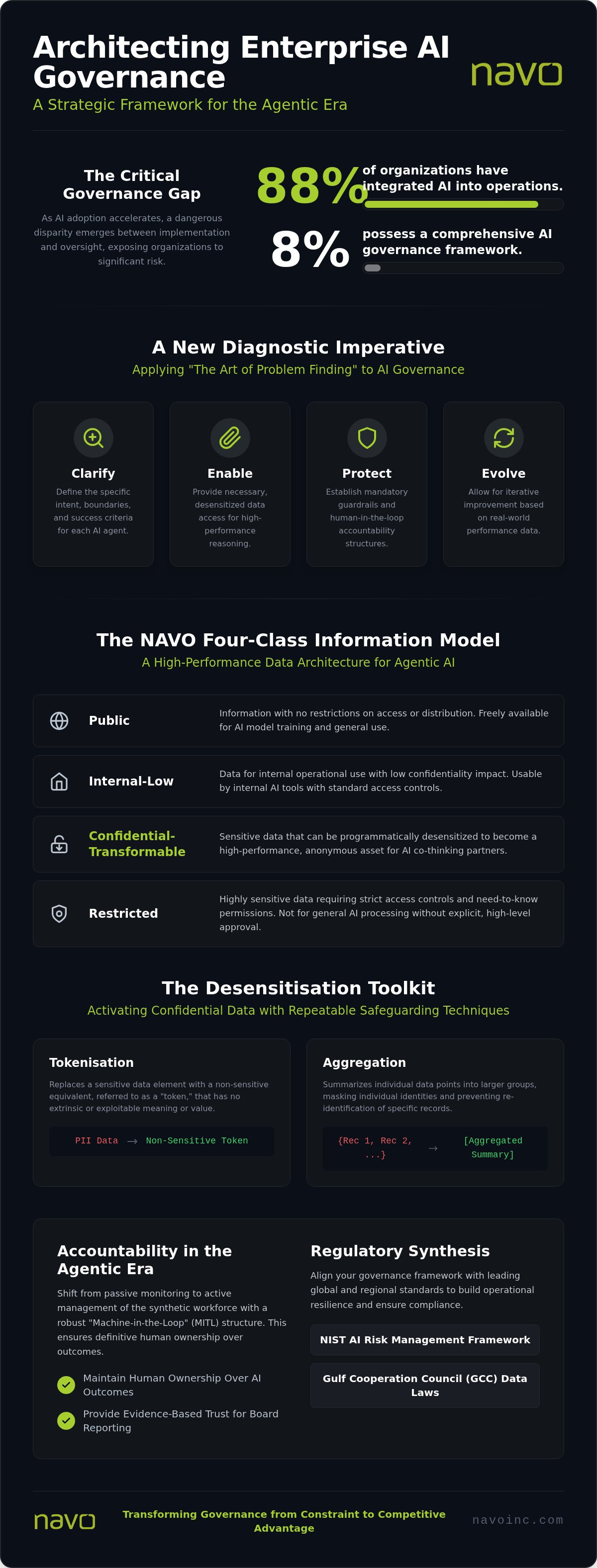
While 88% of organizations have adopted AI, a significant maturity gap exists because few possess the governance frameworks necessary for the rise of autonomous agentic workers. Traditional IT security protocols are insufficient for managing the nondeterministic nature of generative AI, necessitating a strategic shift toward proactive orchestration. By employing the "Art of Problem Finding," organizations can identify systemic vulnerabilities and align technology deployment with long-term business goals. A core component of this transition involves implementing the NAVO four-class information model to segment data effectively and ensure that synthetic agents access only appropriate context. Furthermore, establishing "Machine-in-the-Loop" protocols maintains human ownership and accountability over complex automated workflows. Integrating these practices with rigorous standards like those from NIST and regional GCC regulations allows firms to build the evidence-based trust required for effective board-level reporting. Ultimately, viewing governance as a strategic asset rather than a restrictive barrier empowers companies to scale innovation while maintaining operational integrity.
While nearly 88% of organizations have integrated Artificial Intelligence (AI) into their operations as of mid-2026, a mere 8% possess a comprehensive governance framework to manage the associated risks. This maturity gap is particularly perilous as we transition from passive models to agentic AI, where autonomous synthetic workers execute multi-step workflows with minimal human oversight. You likely feel the mounting pressure from the National Institute of Standards and Technology (NIST) and local Gulf Cooperation Council (GCC) data laws to secure these interactions while maintaining innovation speed. Developing an enterprise AI governance framework isn't just a defensive necessity; it's a strategic orchestration layer required for operational resilience. This article explores our proprietary "Art of Problem Finding" approach to identify systemic vulnerabilities. You'll master a four-class information model for data desensitization and a robust "Machine-in-the-Loop" accountability structure to provide evidence-based trust for board-level reporting.
Key Takeaways
-
Recognize the inherent limitations of traditional Information Technology (IT) governance in managing non-deterministic Generative Artificial Intelligence (GenAI) and adopt the "Art of Problem Finding" as a diagnostic imperative.
-
Implement the NAVO four-class information model, consisting of Public, Internal-Low, Confidential-Transformable, and Restricted classifications, to establish a high-performance data architecture while developing an enterprise AI governance framework.
-
Define specific permitted-use boundaries and Machine-in-the-Loop (MITL) protocols to maintain definitive human ownership over the outcomes generated by synthetic workers like SARA and NOVA.
-
Synthesize operational resilience with the National Institute of Standards and Technology (NIST) and Gulf Cooperation Council (GCC) regulatory standards to facilitate evidence-based trust for board-level reporting.
Table of Contents
-
The Diagnostic Imperative: Applying the Art of Problem Finding to Governance
-
Architecting the Four-Class Information Model and Desensitisation Toolkit
-
Governing the Synthetic Workforce: Accountability in the Agentic Era
The Diagnostic Imperative: Applying the Art of Problem Finding to Governance
Most organizations mistakenly treat Artificial Intelligence (AI) governance as a restrictive extension of Information Technology (IT) security protocols. This approach fails. Generative Artificial Intelligence (GenAI) is inherently non-deterministic, producing varied outputs from identical inputs that traditional binary logic cannot manage. We view developing an enterprise AI governance framework as a strategic orchestration layer rather than a set of limitations. As the global AI regulation landscape shifts toward strict accountability, this framework ensures that innovation doesn't compromise organizational integrity.
We utilize "The Art of Problem Finding" to uncover hidden structural risks before they manifest in deployment. This methodology moves beyond reactive troubleshooting to identify the root causes of misalignment between technology and business goals. It establishes the Clarify-Enable-Protect-Evolve cycle as a foundation for long-term structural excellence. In this cycle, Clarify defines the specific intent of the AI agent, while Enable provides the necessary data access. Protect establishes the mandatory guardrails, and Evolve allows for iterative improvement based on real-world performance data.
Identifying Unknown Unknowns in AI Adoption
Leadership often struggles with the ambiguity of agentic autonomy. This frequently leads to the suppression of "shadow AI" or, conversely, reckless adoption without oversight. Problem Finding in the context of AI risk discovery is the proactive identification of systemic vulnerabilities and strategic misalignments that traditional risk assessments overlook. By moving from reactive suppression to proactive strategic alignment, firms in the Gulf states and Singapore transform AI from a potential liability into a governed, high-performance asset. This shift requires a disciplined architect of change who remains unfazed by the complexity of modern digital frontiers.
Architecting the Four-Class Information Model and Desensitisation Toolkit
Structural stability in the agentic era requires a departure from binary data labels. When developing an enterprise AI governance framework, organizations must adopt the NAVO four-class information model. This architecture segments data into Public, Internal-Low, Confidential-Transformable, and Restricted categories. By categorizing information this way, leadership moves beyond simple protection to active enablement, ensuring that Large Language Models (LLMs) access only the context they require. This alignment with the National Institute of Standards and Technology (NIST) AI Risk Management Framework provides a rigorous foundation for organizations across the Gulf states and Singapore.
The Desensitisation Toolkit serves as the operational engine for this model. It transforms sensitive inputs into high-performance, anonymous assets through the Six Lanes of Working, a methodology ensuring secure data flow across every organizational layer. This process satisfies the requirements of the Information Commissioner’s Office (ICO) while maintaining the utility of the data for synthetic reasoning. For board-level assurance, consulting our governance architects can help bridge the gap between policy and practice.
Twelve Repeatable Techniques for Data Safeguarding
Protecting intellectual property involves twelve specific techniques, including tokenisation, aggregation, and suppression. Tokenisation replaces sensitive identifiers with non-sensitive equivalents, while aggregation masks individual data points within larger datasets to prevent re-identification. These methods allow 'Confidential' data to become 'Transformable' assets, empowering Generative Artificial Intelligence (GenAI) co-thinking partners without risking exposure. Every transformation maintains a rigorous audit trail and a human-ownership mechanism, ensuring that accountability remains central to the automated workflow. This disciplined approach converts data security from a reactive burden into a managed, high-performance discipline.
Governing the Synthetic Workforce: Accountability in the Agentic Era
Developing an enterprise Artificial Intelligence (AI) governance framework requires a fundamental shift from monitoring tools to managing a synthetic workforce. As autonomous agents move from recommendation to execution, the ambiguity of accountability becomes a primary board-level risk. We address this by establishing permitted-use boundaries that define exactly where an agent's authority begins and ends. Central to this architecture are Machine-in-the-Loop (MITL) protocols. Unlike traditional oversight, MITL ensures definitive human ownership of agentic outcomes by embedding mandatory approval gates and feedback loops into the production orchestration.
These checkpoints serve as structural safeguards, providing the evidence-based trust required for board-level reporting. By formalizing these interactions, organizations in Dubai and Singapore can demonstrate a level of auditability that satisfies both local data laws and international standards. This disciplined approach doesn't just mitigate risk; it drives the efficiency necessary to realize our net-profit guarantee through governed, high-performance automation. It's about creating a system where innovation and compliance coexist without friction.
The Role of SARA and NOVA in a Governed Ecosystem
In our proprietary architecture, we distinguish between specialized functions to maintain structural integrity. SARA (Specialized Agent for Response and Analysis) is governed specifically for brief intake and validation accuracy, ensuring that the foundational data for any project is sound. Meanwhile, we manage NOVA for production orchestration, maintaining strict audit trails across complex multi-step workflows. This separation of duties prevents systemic bias and ensures that every AI-generated decision is traceable to a specific human owner. By aligning these synthetic workers with rigorous governance, we transform potential operational volatility into a stable, scalable engine for growth.
Securing Operational Resilience in the Agentic Frontier
The transition from passive tools to autonomous synthetic workers requires a structural shift in leadership perspective. Success depends on moving beyond reactive security toward a disciplined orchestration of data and accountability. By applying our proprietary Art of Problem Finding, organizations identify systemic risks before they compromise integrity. Implementing the four-class information model ensures that data flows securely while maintaining the utility required for high-performance automation. It's clear that developing an enterprise AI governance framework is the definitive pathway to achieving evidence-based trust and board-level assurance. Our CPD UK (Continuing Professional Development United Kingdom) certified GenAI Masterclasses and strategic consulting provide a steady hand for this transformation. We align your technological evolution with rigorous standards to ensure a guaranteed net-profit increase through governed efficiency.
Secure your enterprise's future with a board-level NAVO AI Governance PolicyYour organization is now positioned to lead with confidence in a complex digital landscape.
Frequently Asked Questions
What is the difference between traditional IT governance and Agentic AI Governance?
Traditional Information Technology (IT) governance focuses on deterministic systems with binary logic and fixed input-output paths. Agentic Artificial Intelligence (AI) governance manages non-deterministic synthetic workers that possess autonomous decision-making capabilities. It's a shift from monitoring static software to establishing permitted-use boundaries and Machine-in-the-Loop (MITL) protocols. These structures ensure human ownership over unpredictable outcomes in complex, multi-step agentic workflows.
How does the NAVO Classification Framework handle sensitive customer data in the GCC region?
The NAVO framework utilizes a proprietary four-class information model aligned with Gulf Cooperation Council (GCC) data laws and National Institute of Standards and Technology (NIST) guidance. It segments data into Public, Internal-Low, Confidential-Transformable, and Restricted categories. By applying the Desensitisation Toolkit, sensitive customer information is transformed into anonymized assets through twelve repeatable techniques like tokenisation and aggregation, ensuring compliance while enabling Large Language Model (LLM) utility.
Can an Enterprise AI Governance Framework actually increase net profit?
Continue reading this article on blog.navoinc.com.
About the Author
Vasudevan Kidambi
Managing Director, Navo Inc.
Vasudevan Kidambi is the founder and Managing Director of Navo Inc., with 19 years of experience helping organisations lead in the Generative AI era through consulting, coaching, and synthetic workforce deployment. He writes and speaks regularly on GenAI strategy, AI governance, the future of work, and business transformation.
Want These Ideas in Your Organisation?
From articles to action — our consulting and masterclass programs bring these frameworks to life.
Start a ConversationExplore Related Services
More Insights
Governance of Autonomous AI Agents: An Executive Framework for the Agentic Era
Move beyond passive automation. Learn the governance of autonomous AI agents with our board-level framework to ensure accountability and data sovereignty.
Read More InsightsMitigating Financial Risk in GCC AI: 2026 Framework
A guide to mitigating financial risk in AI transformation projects in GCC. Move from costly experiments to profitable deployment with our 2026 governance fra...
Read More InsightsAI Strategy Services in India: A 2026 Executive Framework for Generative AI Transformation
Unlock real ROI with our 2026 framework for AI strategy services in India. Move beyond tech costs to guarantee net-profit gains with governed Generative AI.
Read More